
Eventually, these users may be nudged toward higher-cost items, increasing both the platform’s income and the user’s satisfaction. Regardless, what appears to be garnering much interest in MPS research is the quantity of leucine consumed (12,13). Current consensus appears to agree that a minimum dose of around 2 to 2.5 grams of leucine is needed per feeding to signal the mTOR pathways that there is adequate dietary protein present to support MPS (14).
For all users groups, the average macronutrient accuracy is over 80%, with the lowest one observed for adults who are overweight (81.69%) and the highest one observed for adults who are obese (86.66%). As a result, the proposed system can generate accurate daily and weekly meal plans even for user profiles not seen before, i.e., not included in the training phase. Nowadays, deep learning methods have achieved outstanding performance in several research areas including nutrition recommendation. Mokdara et al. proposed a food recommendation system that integrates deep neural networks (DNNs) with user-provided favorite ingredients32. Then, a temporal prediction model forecasts future dish recommendations based on the user’s profile and eating habits. Another work proposed an explainable food recommendation system that is based on deep image clustering to incorporate visual content to improve nutrition recommendations33.
- {
- Health recommender systems have emerged as tools to support patients and healthcare professionals to make better health-related decisions.
- Integrating wearable sensor data and mobile health (mHealth) platforms could also enable dynamic feedback loops, allowing real-time adjustment of fitness plans based on user response.
- The resulting low-latency, highly-scalable recommendation service comes with a REST API that enables easy integration with multiple user touchpoints like mobile applications, web platforms, content generation systems, notifications, instant messages, etc.
- The prediction methods mentioned above face some limitations concerning the availability of chemistry structures, considerable required computational power, and a high amount of false positives (Deshpande and Butte 2011).
- Developed by Akhil as a machine learning portfolio project exploring recommendation systems in the fitness domain.
- It uses specialized algorithms and techniques that can support even the largest of product catalogs.
|}{
|}
{
|}
This conversational approach personalizes recommendations in real time, improving satisfaction, guiding decision-making, and turning customer support channels into intelligent product discovery tools. Businesses should evaluate algorithm performance against their use case, scalability needs, and complexity. Start by clearly defining what you aim to achieve with the recommendation engine whether it’s boosting sales, improving user engagement, or reducing churn. A clear objective helps align stakeholders, set measurable KPIs, and guides technology choices to ensure recommendations deliver tangible business impact.
Exercise and Lung Health
Moreover, as these engines are equipped with AI, they utilize their self-learn ability to offer increased engagement levels and decrease churn ratio. Content-based filtering methods are mainly based on the description of an item and a profile of the user’s preferred choices. In content-based filtering, keywords are used to describe the items, whereas a user profile is built to state the type of item this user likes.
Real Estate: Property Recommendations, Market Analysis, Virtual Assistant
It uses specialized algorithms and techniques that can support even the largest of product catalogs. Driven by an orchestration layer, the recommendation engine can intelligently select which filters and algorithms to apply in any given situation for a specific customer. Recommender systems can be used across multiple verticals such as e-commerce, entertainment, mobile apps, education, and more (discussed in detail later). In general, a recommendation engine can be helpful in any situation where there is a need to give users personalized suggestions and advice. In-Situ Evaluation indicates real-life non-laboratory settings that have to be evaluated to prove the worthiness of HRS. This evaluation paradigm should be able to precisely evaluate the ability of HRS to improve the quality of care (concerning accuracy, relevance, and early diagnosis) and reduce the cost of care.
APPROACH® J1
{ |}
|}
The weekly meal plans are analyzed in terms of the accuracy of macronutrients i.e., Fat, SFA, Protein and Carbohydrates and the difference in calories (mean and standard deviation) is reported for each of the 10 user groups of the database. Overall, the system manages to achieve an average macronutrient accuracy of 87% proving that the suggested meals are nutritionally balanced and in accordance with the users’ needs. Furthermore, with the usage of the optimizer that adjusts the meal portions, the calories of the suggested meal plans have no deviation from the recommended energy intake on all user categories.
🧰 Installation and Setup
This raises a critical need to predict potential or missing side effects for drugs (Zhang et al. 2016). One example thereof was proposed by Zhang et al. (Zhang et al. 2016), in which the potential side-effect prediction is formed as a recommendation task. This method is an extension of the classic neighborhood-based recommendation, which utilizes known side effects of similar drugs. We will present the detail of this recommendation method using the following example. Initial recommendations for new users or items might be irrelevant or of low quality.
Performance Metrics
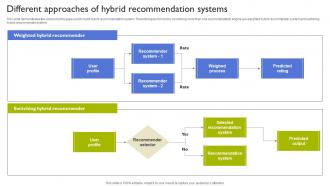
This step minimizes risks and ensures recommendations truly improve customer experience and outcomes. One of the other issues with recommendation systems is the scalability of algorithms having real-world datasets. In most cases, the traditional approach has become overwhelmed by the multiplicity of products and clients, leading to dataset challenges and performance reduction. Compared to pure collaborative and content-based methods, hybrid methods can provide more accurate recommendations.
That’s one of the reasons that you are less likely to become short of breath during exercise over time. The idea of this approach is to combine the aforementioned recommendation techniques to make use of the advantages of one approach and fix the disadvantages of another approach (Ricci et al. 2010). For instance, CF usually faces a cold-start problem triggered when a new item is added to the system and has no user ratings, whereas CB can tackle this issue since the prediction for new items is generally based on available descriptions of these items. Avoid over-personalization and provide a broader user experience by diversifying recommendations. Use smart algorithms to improve conversion rates and boost sales by delivering highly relevant recommendations. Robo-advisors, such as Betterment and Wealthfront, use AI algorithms to provide personalized investment advice.
{
Support
|}
Research shows you have lots of flexibility to use the weights and reps that make sense for you — provided you’re pushing yourself enough. Nothing wrong with doing more targeted work like a bicep curl, which is an example of a “single-joint” exercise. If you want to tap into the many benefits of resistance training — for your cardiovascular health, metabolism, longevity and so on — the researchers who spoke with NPR all recommend prioritizing just a handful of exercises, at least when you’re starting off. Residual analysis confirmed XGBoost’s strong predictive accuracy, with error values tightly distributed around zero (Fig. 5). BRFSS-derived behavioral and environmental variables show meaningful contribution alongside clinical factors. At 8 hours with ANC enabled, these top-tier Sony wireless earbuds outperform the AirPods Pro 2 and have some of the highest battery life of any set of more recently launched earbuds.
{
Future Enhancements
|}
Brolly offers an AI-powered personal insurance concierge that helps users manage their policies, identify gaps in coverage, and recommend better deals. Root Insurance uses AI to analyze driving behavior through a mobile app, tracking metrics such as speed, braking patterns, and phone usage while driving to determine a driver’s risk profile. Platforms such as Coursera and Khan Academy are using AI to provide personalized course recommendations and learning materials. Netflix and Spotify use AI to suggest movies, TV shows, and music tracks tailored to individual user preferences. Netflix reports that its recommendation system saves the company $1 billion a year by reducing churn and increasing user engagement. Introducing product recommendations is one of the most effective upsell and cross-sell methods, increasing order value with personalized item suggestions.
{
Real-Time Contextual Recommendations
|}
Further innovation in behavioral science, user engagement, and data infrastructure will be key to transforming this system into a fully deployable public health tool. First, the NHANES dataset is cross-sectional, limiting our ability to model behavioral change over time or predict long-term health outcomes. Second, some physical activity measures are self-reported, introducing potential recall bias. Although we used validated NHANES survey instruments and conducted sensitivity analyses, future studies should integrate objective sensor-based data from wearables to improve measurement accuracy. Additionally, the dataset shows underrepresentation of certain racial and ethnic minorities, which may have contributed to slightly lower performance in those subgroups. We have addressed this by conducting subgroup-based fairness analysis and one-way ANOVA testing, but future work should focus on data augmentation, stratified retraining, or domain adaptation to improve generalizability.
{
Benefit From a Scalable and Customizable Recommender Engine That Grow With Your Business
|}
Fundamental research in machine learning coupled with increasing health data availability makes individual fitness advice an achievable health care strategy. Evaluating population health datasets by ML models leads to the generation of customized activity programs that optimize care for people while advancing overall health goals. A proposed framework within this paper uses NHANES data to create individualized fitness advice. This method seeks to connect personal healthcare treatments to national wellness goals by delivering a flexible big-data solution that https://www.youtube.com/watch?v=PMMDBTVX5kM raises community health measurement results1.
Some examples of moderate activity include walking briskly, recreational bicycling, gardening and vigorous housecleaning. When you are physically active, your heart and lungs work harder to supply the additional oxygen your muscles demand. Just like regular exercise makes your muscles stronger, it also makes your lungs and heart stronger. As your physical fitness improves, your body becomes more efficient at getting oxygen into the bloodstream and transporting it to the working muscles.